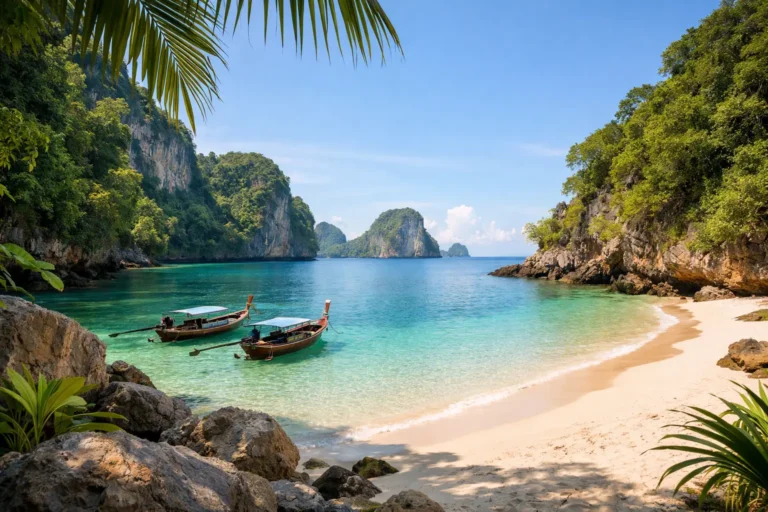
You can ruin a brilliant island-hopping trip by trying to do too much. What looks close on a map can mean a half-day ferry, a missed connection, or one expensive last-minute flight. If you’re figuring out how to plan island hopping, the real skill is not squeezing in the most islands. It is building an itinerary that gives you movement, margin, and enough time to actually enjoy where you are.
Island hopping works best when the journey is part of the appeal. Think Greek ferries between Cycladic villages, slow boats in Tajska, inter-island flights in Havaji, or road-and-ferry combinations in Scotland and Irska. Each destination has its own rhythm, and your plan should follow that rhythm rather than fight it.
How to plan island hopping: start with the route, not the wishlist
Most people begin with a list of beautiful islands and then try to force them into one trip. A better approach is to start with the transport network. Which islands are linked directly? How often do ferries run? Are there seasonal schedules? Do crossings depend on weather? These questions will shape your trip more than social media ever will.
A good route usually has one of three forms. It can be a loop that brings you back to your starting point, a line that starts on one island and ends on another, or a hub-and-spoke plan where you stay on one base island and take day trips. None is automatically better. It depends on your budget, your luggage tolerance, and how often you want to pack and unpack.
If ferries are frequent and short, moving every two or three nights can work well. If transport is patchy or weather-sensitive, a hub-and-spoke approach often saves stress. In places with expensive flights or infrequent boats, open-jaw itineraries can make more sense than returning to where you started.
Pick fewer islands than you think you need
This is where better trips are made. Three islands in ten days often feels richer than five islands in the same period. You spend less time in queues, less money on transfers, and far less energy reorienting yourself.
Each island should earn its place. One might be for beaches, another for hiking, another for food or nightlife, and another for a quieter final stretch. If two islands offer almost the same atmosphere, keep the one that is easier to reach or better connected to the rest of your route.
A useful rule is to match the number of islands to the time you actually have, not the time you imagine you have. Travel days are rarely full sightseeing days. Even a simple ferry crossing can take up the best part of a morning once you factor in check-out, port transfers, waiting time, boarding, and finding your next accommodation.
Match island choice to your travel style
Independent travellers often do best with a mix of one easy island and one or two more characterful stops. That gives you a soft landing at the start or end of the trip while still making room for places that feel less packaged.
If you are travelling as a couple, you may care more about room quality, sunset spots, and keeping transfers smooth. If you’re travelling with friends, nightlife or activity options might matter more. Solo travellers often benefit from islands with walkable towns, sociable guesthouses, and transport that does not rely on hiring a car.
Build around transport reality
Transport is where island-hopping plans either become efficient or fall apart. Before booking accommodation, check how the route works on actual travel days. A ferry that runs daily in August might run three times a week in shoulder season. A flight that looks cheap might involve baggage fees that alter the maths.
Weather matters too. In some destinations, wind can disrupt ferries, and in others, rough seas can turn a short crossing into an unpleasant one. If you have an international flight home, avoid planning a same-day ferry arrival unless the connection is very dependable. Give yourself a buffer night on your departure island or mainland gateway.
When comparing ferries and flights, think beyond price. Ferries may be cheaper, but they can also consume more of your day. Flights save time, yet airports are often farther from town than ports are. There is no universal best option – only the one that fits your route and priorities.
Leave margin for missed connections and bad weather
The tighter the itinerary, the more fragile it becomes. One delayed ferry can affect two hotel bookings and a pre-booked excursion. Build margin into your route, especially in remote archipelagos or during shoulder seasons.
This does not mean planning timidly. It means being realistic. If one island is notorious for weather disruptions, place it mid-itinerary rather than at the very end. If boats are less reliable in the afternoon, travel earlier. If a crossing is long, avoid pairing it with a same-day activity you care about.
Budget for the hidden costs
People often budget for accommodation and big transport, then get caught out by the small but constant costs of moving around. Port taxis, baggage storage, seat upgrades, airport transfers, and higher last-minute fares can all add up quickly.
Island hopping is usually more expensive than staying put, so decide where flexibility matters most. You might splurge on a direct speedboat to save half a day, then choose simpler accommodation on one stop to balance it out. Or you may stay longer on one island to reduce overall transport spend.
Food costs can vary sharply between islands too. A polished resort island may cost far more than a working island nearby. If your budget is tight, it can make sense to mix one higher-cost stop with one more local, lower-key base. That often creates a more interesting trip anyway.
Book the fixed points first
When deciding how to plan island hopping, book in order of scarcity. Start with the transport legs that are hardest to replace, then secure accommodation on islands with limited stock, especially in peak season.
That usually means locking in inter-island ferries or flights first, then booking places to stay near ports or in the most practical area for your arrival. Activities can often come later unless there is something very specific you would be disappointed to miss.
Try not to overbook every hour. One of the best parts of island travel is the room to linger – a swim that turns into an afternoon, a harbour lunch that becomes sunset drinks, or a beach you return to because the weather is perfect. A plan should support spontaneity, not eliminate it.
Pack for movement, not just for the photos
A suitcase that feels manageable in a hotel lobby can feel ridiculous on a steep quay, a gravel road, or a small guesthouse staircase. The more often you move, the more your luggage matters.
Pack lighter than you think you need. Prioritise easy-dry clothing, solid footwear for uneven paths, and a day bag that works for boat days. If your route includes ferries, keep valuables, medication, and one change of clothes with you rather than buried in your main bag.
This is especially true if you are combining beach islands with active ones. The prettiest route is not always the easiest, and some of the best island stops are also the least set up for heavy luggage and polished resort logistics.
Choose the right pace for the destination
Not every island chain rewards fast travel. In some places, like parts of Thailand or Greece, moving every few days can be straightforward and fun. In others, such as more remote Pacific or North Atlantic islands, the effort of each transfer means slower travel usually pays off.
Ask yourself what you want the trip to feel like. If you want variety and energy, a quicker pace can work. If you want immersion, keep the number of stops low and spend longer on each. There is no prize for ticking off islands you barely experienced.
For many travellers, the sweet spot is a trip with contrast rather than quantity. One lively island, one scenic island, and one slower final stop often creates a better rhythm than a chain of places that all blur together.
A sample framework that works
For a 10-day trip, a simple structure is often enough. Start with two nights on your arrival island to recover and get your bearings. Move to a second island for three nights if it offers the main activity or scenery you came for. Finish with three or four nights on an island that is either close to your departure point or easy to connect from.
That framework gives you a proper start, a meaningful middle, and an end that is not spent watching the clock. It also leaves enough room for weather shifts or transport changes without wrecking the whole holiday.
If planning all of that sounds appealing but fiddly, that is exactly why some travellers prefer small-group trips with clear routing and no hidden surcharges. The best ones keep the adventure while removing the admin.
The smartest island-hopping itineraries are not the busiest ones. They are the ones that leave you with time to swim before breakfast, catch the local rhythm, and still make the next boat without panic. Plan for that version of the trip, and the islands have a much better chance to feel like places rather than stops on a checklist.